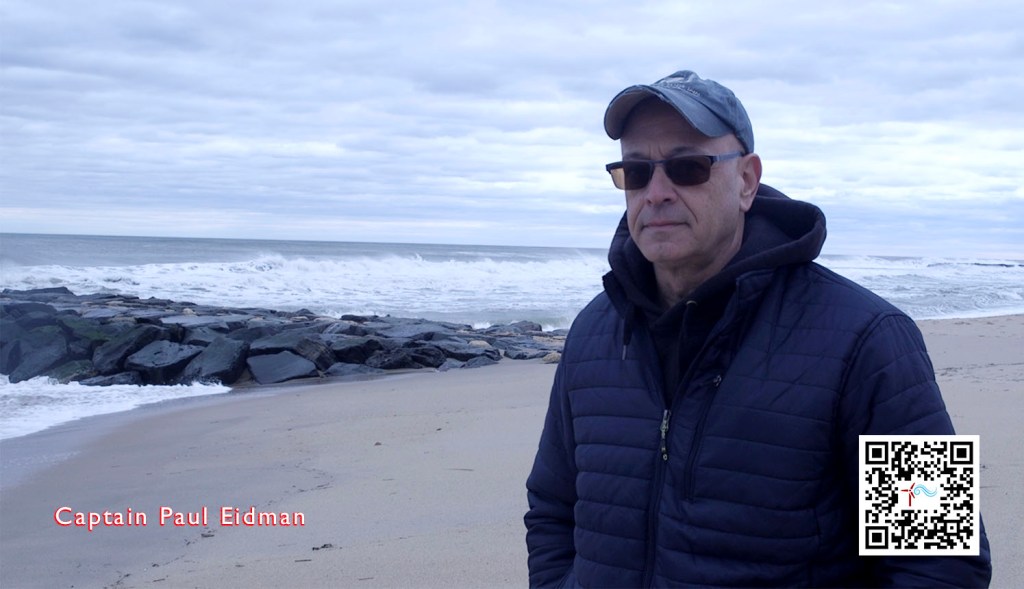
During the research of this documentary, I did many trips to the shore, and in one of those trips, I met Captain Paul Eidman, a Sandy Hook fishing charter boat owner. Captain Eidman is a fourth-generation fisherman following his father, his grandfather, and his great-grandfather’s tradition in the ocean; he has been a recreational fishing charter captain for 26 years right now, as he said, he was fishing from the time he was in diapers.
“From the time I was in diapers, I’ve been fishing.”
The local fishing community is concerned about the Offshore Wind Project because they believe will change the industry in our state. Captain Eidman does not believe that; he thinks all types of fishing can coexist with the Offshore wind farms. He remarks that the fishing community is split between recreational and commercial fishermen. As well, he knows that commercial fishermen absolutely do not want the turbines in the water, whereas recreational fishermen are looking forward to them because it will be places where fish aggregate, and they are going to be able to target them depending on the season, there will be fish down on the bottom, and there will be fish up top. The turbines are going to be about a mile apart from the other, and ships are going to be able to navigate in between them. Captain Eidman comments that this is one of the biggest concerns about the spacing that comes from the commercial shipping traffic because they want their own lanes away from the wind farm. He aggregates that the base of each wind turbine is going to be like a fish attractor because will be a large diameter of rocks, and these bases with the monopile in the center will create a natural artificial reef. Captain Eidman states that fishermen will see the beginning of those reefs in a couple of months after the turbines will be established on the bottom, first will appear the microfauna and mussels, then small and medium fishes will arrive exponentially from there.
Captain Eidman knows fishermen don’t take it to the level he has taken it to because he is not only a professional captain, but also a marine fish conservational advocate. He is actively working on fisheries issues, renewable energy, and offshore wind; his goal is to be sure that recreational fishermen have a seat at the table when a lot of these decisions are made.
Captain Eidman explains that it will be three wind farms coming up along the New Jersey coast, one to the north of Sandy Hook that will be called Empire Wind and will be located about 17 miles offshore, but that’s at the starting point from here, it’s going to probably be 25 miles off. Roughly speaking, there is going to be about 60 turbines, and that’s going to power New York. And then as we go further south, there will be two wind farms, kind of on top of each other. The first one is called Atlantic Shores, and the one right below is the Ocean Winds, those two will power New Jersey. Captain Eidman highlights that Ocean Winds should be coming at the end of 2024, or early 2025, and they will be roughly 15 miles from the shore extending out almost a hundred miles, the conditions must be extremely good in order to see them at all, even at the closest point.. He points out that the visual pollution angle is critical because some locals may have an elitist perspective, “not in my backyard”. He knows there are people that might have a summer home on the shorefront, and they don’t want to affect their views shed. Turbines won’t be visible from Sandy Hook, and even if is visible it would be as big as a pinky fingernail, and very tiny, you’ll need binoculars.
Captain Eidman also comments about the other big concern of our community over the humpback whales that are washing up on our shorelines, he has direct experience with sonar equipment used to map the shores, and he says that those tools are not the cause because the sonar array operates at a very low frequency, it is almost silent and harmless to animals; also, the sonar is located on the offshore wind survey vessel. He advises that the story about whales dying because of the sonars is a narrative fabricated to stop or delay offshore wind from occurring. Furthermore, Social Media and all the political opposition spread those myths rapidly.
Captain Eidman highlights that in each vessel expedition, there are protected species observers on the deck that are in constant lookout for whales, dolphins, and turtles; if they sight anywhere near the work, they have the ability to stop the work until the animal clears the safe zone. This is very important to avoid marine mammals interacting with the survey vessel.
We know that the more renewable energy we have, the better will be, and Captain Eidman has a vision of an excellent future for commerce and recreational fishing; also, will be good for the air we breathe, and the water we drink, so the Offshore Wind is a positive thing and It represents change and people don’t like change, especially fishermen.
 Winds of Change
Leave a comment