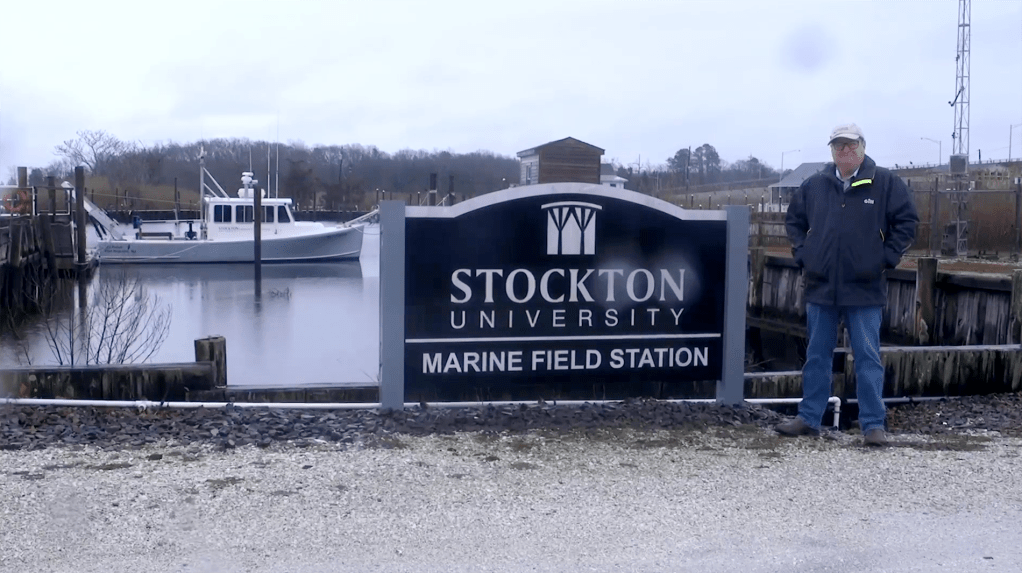
One of my favorite parts of this research was visiting the shore towns, talking with the local community, and meeting academics and scientists who are working on amazing projects regarding Offshore Wind energy in our shores.
At the end of 2022, I met Professor David Straub from Stockton University, he is a Professor of the Marine Science department and he invited me to explore the Marine Field Station in Atlantic City.
During our conversation, he told me that his interest in mapping the bottom of our shores started in 2008. His goal is to have good maps to know ocean invertebrates colonizing the bottom of our Ocean because, in that way, he and his team can learn about the fish visiting our shores, but finally understand the things that come in and prey on them, the people.
Professor Straub told me that they use two techniques for mapping; one is called Side Scan Sonar, and the second is the Multibeam Sonar. Both sonars use a pulse of sound to paint a picture of the bottom, but besides that, they also calculate the exact depth and position. The Scan Sonar is towed behind the vessel and is cabled into the computer which allows the scientists to get a digital map of the bottom.
At this time, when the Offshore Wind Project is in the development stage, the mapping of the bottom is very important because the wind turbines or monopods will have an impact on the bed of the sea.
Furthermore, he added that the sea can be a noisy place, we find drum fish and all kind of fishes of that family that make noises, and of course, marine mammals make noises as well; so, there is a lot of sounds down there. Besides dishes, there are boat propellers, ship propellers, and a large number of noise-making things in the ocean in general. The noise produced in the Ocean is an important topic because construction jobs will affect the local community during the first phases of the project, and it may be the loudest part of any underwater operation. To avoid serious consequences, Professor Straub suggests that there are a number of things that can be done including using acoustic bubble curtains around the construction zone.
The researcher also commented that there are observers on site to make sure that there aren’t any migrating mammals or any other type of fish that could be impacted by that construction.
During my visit to the Marine Field Station, Professor Straub had the opportunity to speak about the number of beached whales that have been happening during the past two years from the Eastern part of Long Island to Southern New Jersey in this area where there was a stranding of a humpback whale recently. The community has some concerns that maybe working on wind farms but there is no direct evidence that links those tragedies with the work on the wind farms. He added that there are a lot of activities that go on in the Ocean all the time like dredges out doing beach replenishment, ships transiting between all kinds of ports in the ports of New York City and Philadelphia; and a number of factors that can be the reason of those stranding. He remembers that marine mammals have been shown to be susceptible to being hit by boats; furthermore, the population is just much higher because many of these species are endangered species, so they have been protected for a good period.
Finally, Professor Straub tells us that he is a strong supporter of Offshore Wind, he lives at the shore and he is a witness of what climate change and rising sea water are doing to the shorelines, the state is spending enormous amounts of money to pump sand onto the shores to protect our islands, but we are doing very little to reduce carbon and slow down global warming which causes expansion of the Earth and causes more siding sea levels.
 Winds of Change
Leave a comment